
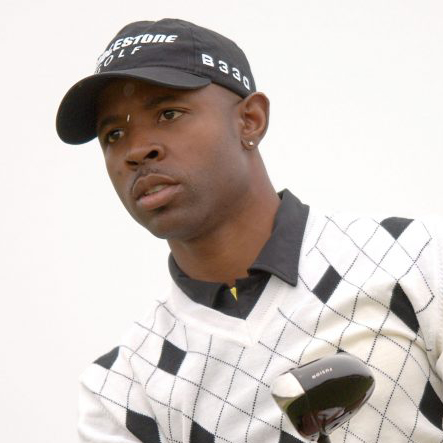
John Shipen, Calvin Peete, Jim Thorpe, Lee Elder, Charlie Sifford, Chuck Thorpe, Jim Dent, Pete Brown, Vaugh Taylor, Tom Woodard, Henry Carl Baraben, Cliff Brown, George Johnson, Charlie Owens, Curtis Sifford, and others blazed a trail for Tim O’Neal and the current list of young Black professionals who’ve chosen to follow a hallowed path to the PGA Tour without benefit of wealth and privilege.

Tim O’Neal’s professional golf career has long been defined by resilience. For nearly three decades, the Savannah, Georgia native navigated the margins of elite professional golf, chasing a dream that repeatedly seemed just out of reach. When O’Neal finally arrived on the PGA Tour Champions—often referred to as the Senior PGA Tour—his story resonated as one of the most compelling in the game: a testament to patience, faith, and persistence rewarded.
O’Neal turned professional in 1997 after a successful amateur career and a collegiate stint at Jackson State University, an HBCU that played a central role in shaping his journey. His early professional years were spent grinding across multiple tours, including the Web.com Tour (now the Korn Ferry Tour), PGA Tour Latino América, and international circuits in Europe, Africa, and South America. Along the way, he collected victories—most notably three wins on PGA Tour Latino América—and built a reputation as a world-class ball striker who simply never stopped competing.
What haunted O’Neal, however, were two near-misses at PGA Tour Q-School. On two separate occasions—in 2000 and again in 2004—he missed earning a PGA Tour card by a single stroke, including a painful final-round collapse that became part of golf’s lore of heartbreak and “what ifs”. Those moments might have ended many careers, but for O’Neal, they became fuel.
As opportunities narrowed, O’Neal found both purpose and community on the Advocates Pro Golf Association (APGA) Tour, where he became an elder statesman and a symbol of perseverance. The APGA not only kept his competitive edge sharp but also aligned him with a mission to diversify professional golf, further cementing his legacy beyond scorecards.
O’Neal’s long-awaited breakthrough came after he turned 50. In 2022, he earned status on PGA Tour Champions through Q-School, officially opening the door to golf’s senior circuit. His first full season on the Champions Tour was a study in survival and belief. Competing against Hall of Famers and major champions, O’Neal battled inconsistency, injuries, and the constant pressure of maintaining his card. At times, his status on the tour hung in the balance.
Everything changed in October 2024 at the Dominion Energy Charity Classic. Closing with a brilliant final-round 65, O’Neal made clutch birdies down the stretch to secure his first PGA Tour Champions victory at age 52. The win was more than a trophy—it delivered a $350,000 paycheck, locked up his tour status, and validated decades of belief when belief alone had to be enough. For many observers, it was one of the most emotionally significant wins of the Champions Tour season.
That first year on the Senior PGA Tour transformed O’Neal from journeyman to proven winner. It also allowed him to plan his schedule with confidence rather than uncertainty, a luxury he rarely enjoyed earlier in his career.
Looking ahead to 2026, expectations for Tim O’Neal are grounded but optimistic. With a full season of Champions Tour experience and the confidence that comes from winning, O’Neal is positioned to contend more regularly. His ball-striking remains elite, and with improved health and consistent access to events, multiple top-10 finishes are realistic. More importantly, O’Neal now competes without the existential pressure of simply surviving week to week.
Beyond results, O’Neal’s role as a mentor and symbol of perseverance will continue to define his presence on tour. In a Champions Tour filled with legends, Tim O’Neal stands apart—not just for how he plays, but for how long and how faithfully he kept believing. As 2026 evolves, his journey serves as a reminder that in golf, and in life, some victories are decades in the making.